
Storks in Alsace: Where to See Them in 2026? The Complete Guide
Updated in April 2026 — Reading time: 13 min
Do you dream of seeing Alsace’s famous storks in their natural habitat? Indeed, this large wading bird with black-and-white plumage has been the region’s iconic symbol since the Middle Ages. In fact, after nearly going extinct in the 1970s, the white stork has now returned in large numbers thanks to an exemplary conservation program. In fact, several hundred pairs now nest each spring between Strasbourg, Colmar, and Mulhouse.
In this guide, we share the 6 best places to see storks in Alsace, the best time of year to spot them, and our Nexvisit accommodations, which are ideally located for exploring the various sites. In addition, for the latest details on opening hours and events, we also recommend checking the parks’ official websites, where the staff continuously update the information.
📋 Table of Contents
🐣 Storks in Alsace: A Unique Conservation Story

It is impossible to talk about storks in Alsace without mentioning the conservation program that saved the species from extinction. In fact, by the 1970s, the white stork had virtually disappeared from the Alsatian landscape. In fact, only a few breeding pairs remained in 1974, compared to several hundred at the beginning of the 20th century. There were multiple causes for this decline: power lines, pesticides, drought in African wintering grounds, and the loss of wetlands.
In light of this alarming situation, a reintroduction program was launched in Hunawihr as early as 1976. Specifically, the plan involved keeping storks in captivity for three years to break their migratory instinct, and then releasing them. In addition, similar initiatives were quickly launched in Kintzheim and Munster. As a result, the population has gradually recovered, and there are now more than 600 breeding pairs in Alsace. In short, a rare ecological success story in Europe.
🗺️ Where can you see storks in Alsace? The 6 best spots

Storks in Alsace are now found throughout the region, from the Bas-Rhin to the Haut-Rhin. However, some locations offer better chances of spotting them than others. Here are our 6 favorite spots, all tested by our family.
1. NaturOparC (Hunawihr) — the historic sanctuary
Just a few miles from Ribeauvillé, NaturOparC (formerly the Stork and Otter Reintroduction Center) is the birthplace of the conservation program. In fact, this is where it all began in 1976. Today, the park is home to more than 150 storks living in semi-freedom within a lush green setting. In addition, the site offers an animal show featuring otters, cormorants, and penguins, as well as a fascinating educational trail.
In practical terms, expect to pay around €12 for an adult and €8 for a child; the park is open from April through early November. The highlight of the visit is the storks’ great free flight in the late afternoon. Address: Route des Vins, 68150 Hunawihr. For more information, visit the official website at naturoparc.fr.
2. Cigoland (Kintzheim) — a family park dedicated to storks
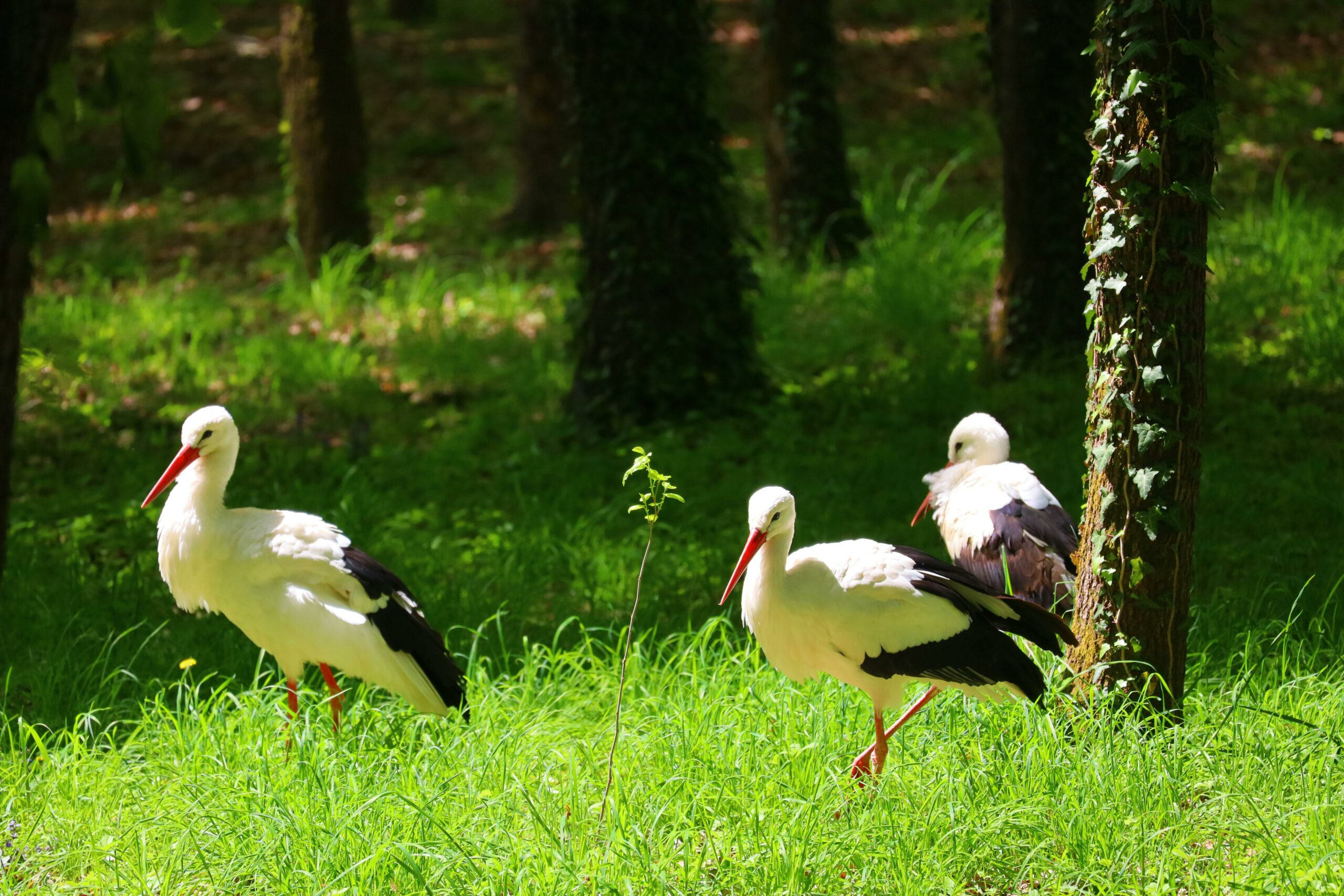
Located in the heart of the vineyards in Kintzheim, Cigoland is the only amusement park in the world entirely dedicated to storks. Founded in 1975, it is home to more than 200 storks that roam freely among attractions designed for children. In addition, the park features a monorail, bumper boats, a ghost train, and about fifteen other family rides.
In practice, expect to pay around €18 per person (ages 2 and up), with the season running from April through early November. This makes it the perfect spot for a family day out combining wildlife viewing and fun. Address: Route de Sélestat, 67600 Kintzheim. In particular, the daily feeding of the storks (at set times) is a sight not to be missed.
3. Volerie des Aigles (Kintzheim) — birds of prey and a medieval castle
Also in Kintzheim, but just a few hundred meters from Cigoland, the Volerie des Aigles is located within the majestic ruins of the medieval castle. This spectacular site offers free-flight demonstrations featuring eagles, vultures, kites, and owls. In addition, several pairs of storks nest on the castle ramparts, adding to the charm of the place. What’s more, the climb up to the castle offers an exceptional view of the Alsace plain.
As for prices, expect to pay €12 for adults and €8 for children. However, be sure to wear sturdy shoes: the hike from the parking lot takes about 15 minutes along a forest trail. The demonstrations last about 40 minutes and are held several times a day during peak season.
4. Alsace Ecomuseum (Ungersheim) — storks and rural heritage

In Ungersheim, near Mulhouse,the Écomusée d’Alsace is France’s largest open-air museum. It features more than 70 traditional Alsatian buildings reconstructed to form a real, living village. In fact, many pairs of storks nest on the thatched roofs and chimneys, offering visitors extraordinary photo opportunities. You can also enjoy craft demonstrations, horse-drawn carriage rides, and traditional workshops.
As for the cost, expect to pay €17 for adults and €11 for children for a full day. This is undoubtedly the site that best combines stork watching with an immersion in Alsatian culture. In particular, the Christmas evenings at the Ecomuseum have become a must-see event at the end of the year.
5. Parc de l’Orangerie (Strasbourg) — free and right in the heart of the city
Good news for those on a tight budget: you can see storks for free right in the heart of Strasbourg! The Parc de l’Orangerie, located right next to the European Parliament, has been home to a historic stork enclosure since 1971. In fact, it was one of the first conservation sites established in Alsace. In addition, the park also features a petting zoo, a lake with rowboats, and plenty of walking paths.
As for access, the park is open every day and completely free. This makes it the perfect spot for a nature break in the city, especially if you’re staying at one of our Nexvisit vacation rentals near Strasbourg. Access: tram lines E or F, “Droits de l’Homme” stop.
6. Watch wild storks in the villages
Finally, the most wonderful experience is undoubtedly watching storks in the wild in Alsace, perched on chimneys, church steeples, and the roofs of half-timbered villages. Here are our favorite villages for this free activity:
🏘️ Hunawihr
Around NaturOparC Park, many pairs of birds nest on the village rooftops.
🏘️ Ribeauvillé
Perched at the foot of the Vosges Mountains, the village is home to several spectacular nests.
🏘️ Munster
The "City of Storks" in the Haut-Rhin department, featuring a stork park in the center.
🏘️ Eguisheim
France's Favorite Village 2013: half-timbered houses and bird nests on the rooftops.
🏘️ Turckheim
Famous for its night watchman, it is also home to several breeding pairs.
🏘️ Sélestat
Nests visible from downtown and on the roofs of the old hospital.
📅 When is the best time to see storks in Alsace? The ideal schedule
The question of when is just as important as the question of where. In fact, migratory storks are only visible for part of the year, even though most of them are now sedentary. Here is the schedule you need to know.
🎭 Storks in Alsace: Did you know?
Beyond the conservation program, the stork is surrounded by legends, symbols, and surprising stories. Here are 6 amazing facts to impress your friends and family.
🍼 The Legend of the Babies
According to an old Alsatian belief, storks bring babies by scooping them up from the ponds of the Ried. In Strasbourg, in particular, some families still leave a sugar cube on the windowsill to “order” a child.
📏 An XXL wingspan
The white stork has a wingspan of up to 2.20 meters and weighs 4 kilograms. In fact, it can travel up to 500 kilometers a day during its migration to North Africa or the Sahel.
🔇 A silent bird
Contrary to popular belief, storks do not sing. In fact, they communicate solely by clacking their beaks—that distinctive sound heard in the spring on the rooftops of Alsace.
🏠 A 500-kg nest
Stork nests, which the pair expand each year, can weigh up to 500 kg and measure 2 meters in diameter. In fact, they are reused for decades by successive generations.
💑 Loyal, but not too much
Storks are loyal… to their nests, more so than to their mates. In fact, both males and females return to the same nest every year, but not necessarily at the same time or with the same mate. However, pairs often stay together for several years.
🚫 Nine couples in 1974
In 1974, there were only 9 breeding pairs of storks left in Alsace. Thus, without the Hunawihr program launched in 1976, the species would have disappeared from the region. Today, there are more than 600 pairs!
🛏️ Where should you stay to see storks in Alsace?
Now that you know where and when to spot storks in Alsace, all that’s left is to find the right place to stay. At Nexvisit, our vacation rentals are ideally located for exploring the various stork sites, from Strasbourg to Colmar. In fact, every property includes professional cleaning, hotel-quality linens, and WiFi—with no hidden fees. Plus, 24-hour self-check-in gives you complete flexibility to head out early to watch the storks at sunrise.
For families and large groups: La Maison Royale

For families and small groups: The Terra Nova

For a deep dive into the Wine Route: La Maison Paisible

All our accommodations in Alsace
Furnished houses, apartments, and studios. Cleaning and linens included; 24-hour self-check-in.
See all our accommodations →📌 Practical information for stork-watching in Alsace
🚗 Sample weekend itinerary
Saturday: Parc de l’Orangerie (Strasbourg) in the morning, then Kintzheim in the afternoon (Cigoland + Volerie des Aigles).
Sunday: NaturOparC Hunawihr + a stroll through the wine-growing villages (Ribeauvillé, Riquewihr).
📍 Useful links
Our Nexvisit accommodations — book directly with no commission
Wine Route Guide — extend your stay
Complete Guide to Alsace — activity ideas for 2026
❓ Storks in Alsace: Frequently Asked Questions
Observation and season
When is the best time to see storks in Alsace?
The best time to visit isfrom April to July. This is when the migratory storks return, pairs nest, and the chicks grow in their nests. In fact, May offers the most beautiful family scenes. However, resident storks can now be seen year-round in the parks (NaturOparC, Cigoland, Parc de l’Orangerie).
Can you see storks for free in Alsace?
Yes, absolutely. In fact, the Parc de l’Orangerie in Strasbourg is completely free to visit. In addition, the wild nests on the rooftops of villages (Hunawihr, Ribeauvillé, Munster, Eguisheim, Turckheim) can be viewed freely from the street. So, a simple walk is all it takes to admire the storks without spending a penny.
Parks and Admission Fees
What is the difference between NaturOparC and Cigoland?
NaturOparC (Hunawihr) has been a historic stork reintroduction sanctuary since 1976, with a focus on education and wildlife (otters, cormorants, penguins). Cigoland (Kintzheim), on the other hand, is a family amusement park with rides and storks roaming freely. In fact, the two sites complement each other perfectly for a weekend trip.
Do the storks of Alsace still migrate?
Yes and no. While some storks still migrate to North Africa or the Sahel from September to February, since the conservation program began, most of the storks in Alsace have become sedentary and now spend the winter there. As a result, they can be seen year-round in parks and in some villages.
How many storks live in Alsace today?
There are now more than 600 breeding pairs in Alsace, or approximately 1,500 to 2,000 individuals when including this year’s chicks. This is a remarkable figure compared to the nine pairs remaining in 1974. As a result, Alsace remains the leading region in France for the white stork.
Ready to follow in the footsteps of the storks of Alsace?
From the spectacular nests in half-timbered villages to modern sanctuaries like NaturOparC, stork-watching in Alsace remains one of the region’s most moving experiences. Indeed, as a symbol of conservation, a cultural icon, and a natural spectacle, the Alsatian stork perfectly embodies the spirit of the region. What’s more, each site offers a different experience, ranging from educational parks to wild birdwatching.
So now that you know exactly where and when to see storks in Alsace, all that’s left is to book your accommodation. At Nexvisit, our all-inclusive vacation rentals are waiting for you, complete with housekeeping, linens, and self-check-in. Plus, by booking directly, you’ll get the best rates—with no commission. Finally, to extend your stay, be sure to check out our comprehensive guide to the Wine Route.
Article published in April 2026 — Nexvisit
SAS Nexvisit — Manager of vacation rentals in Alsace — www.nexvisit.com